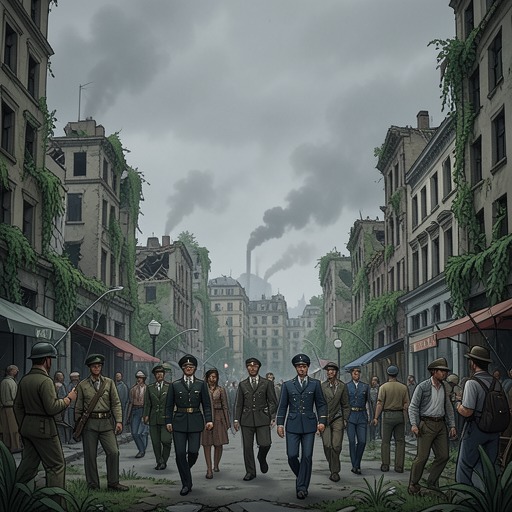
Execution of Onswa
Systema Delenda EstExecution of Onswa is the public beheading of Onswa by Grand Paladin Nikhil Tornok, a Clan Tornok Bismuth who seizes control of Sydea and declares that the world will be returned to the guidance of the divine System. The act is both a political execution and a demonstration of overwhelming rank power: Onswa, celebrated as Onswa the Unstoppable, is reduced from an apparently untouchable Platinum administrator to a bound prisoner and then a grisly emblem of obedience. Its decisive consequence is not only death, but the sudden conversion of Sydea’s public space into a stage on which Nikhil defines rebellion as a crime punishable by annihilation.
Seizure of Sydea and the Display of Rank
Nikhil emerges from the top of the Nexus in gleaming golden armor marked with Clan Tornok’s crest, dragging Onswa behind him. The armor is described as so finely made that each piece may be worth more than all the equipment on Sydea taken together, making the paladin’s appearance an immediate visual statement of concentrated clan wealth and divine privilege. His furred, rodent-like face appears cruel and bitter to Raine, while the pressure of his Bismuth presence makes the difference between ranks physically unmistakable. Raine had understood the strength of a Bismuth in theory, but Nikhil’s arrival makes that hierarchy tangible.
Onswa’s condition supplies the sharper contrast. His strange aether energy had made him impossible to stop, slow, trap, or deflect, earning him the title Onswa the Unstoppable. Nikhil nevertheless restrains him in golden-glowing bonds that clamp his arms to his sides and bind his tail and legs together, suspending him behind the paladin on a lead formed from the same divine energy. The restraint does not merely imprison Onswa; it publicly disproves the reputation that had defined him. Against Bismuth power, the advantages that made him exceptional are rendered irrelevant.
Nikhil orders everyone into the square with a voice whose volume is itself presented as a privilege of Bismuth rank. The gathered outworlders and Sydeans obey, while Raine and Leese recognize that the command is more than crowd control. Nikhil is assembling witnesses. The square becomes a forced audience for the restoration of divine authority, and Onswa is positioned as its principal example.
The Execution as Political Theater
Nikhil announces that all Platinums are complicit with the enemy and that the rot must be cut out by the roots. He attributes Sydea’s crisis to the elevation of those who rebel against the divine System, leaving open the possibility that someone may advance far enough to govern the population—or that no such advancement will be permitted. The statement transforms a personal punishment into a doctrine: the killing of Onswa is meant to justify the removal of Sydea’s existing leadership and to warn every observer that service to the System is the only recognized form of legitimacy.
Onswa does not plead or attempt to speak against Nikhil. He keeps his head raised and his shoulders set, remaining calm and collected even while imprisoned. That composure creates the scene’s central moral and visual tension. Nikhil claims the authority of gods and systems, but Onswa’s silence refuses to supply the submission that the spectacle demands. The execution therefore has to proceed through force rather than confession or repentance.
Nikhil reaches toward Onswa and tears his head from his shoulders. The violence is immediate and physically appalling, a sound that remains in Raine’s nightmares. Nikhil then holds the severed head by one of its horns and presents it to the crowd before tossing it carelessly among them. His explanation is blunt: this is what comes of defying the gods. The head becomes a portable symbol of the message he wants Sydeans and outworlders to carry away—divine protection is absolute, rebellion is futile, and even a figure known as unstoppable can be displayed as proof of the System’s power.
Leese darts forward and catches the head. Her action interrupts the intended meaning of the spectacle. Instead of allowing Onswa’s remains to become anonymous evidence of defeat, she takes responsibility for them in full view of Nikhil and the crowd. Raine immediately understands both the danger and the possibility in that gesture: Leese has drawn attention to herself, yet the head may still contain a chance for Onswa’s survival. The public execution thus produces an unintended counter-image, in which an object meant to enforce despair becomes something allies can rescue.
Consolidation of Divine Control
After the execution, Nikhil turns from the crowd to the city itself. With a brief gesture, he makes the golden dome over Sydea vanish, removing the visible barrier that had enclosed and protected the settlement. He then forbids off-world travel until every Platinum has been brought before him. The restriction converts the city from a controlled but functioning community into a sealed space of pursuit, where movement depends on compliance with the new regime. His promise that travelers may leave once the Platinums are delivered makes departure conditional upon collective betrayal: escape is offered, but only through participation in the purge.
Nikhil also permits the System quest to continue while declaring that he will remove its real source. This distinction exposes the political logic of his intervention. He does not present himself as abolishing Sydea’s System-bound order; he claims to be restoring its proper divine guidance by eliminating the administrators who have become capable of resisting it. The execution of Onswa therefore inaugurates a broader threat against every Platinum on Sydea, while the crowd is left to understand that the city’s former leadership no longer provides protection.
Escape and the Possibility of Resurrection
Nikhil disappears into the Nexus, apparently teleporting elsewhere, but the danger expands rather than ends. Raine recognizes that his announcement has revealed the absence of higher-ranking defenders and effectively marked all Platinums for death. The outworlders, many of whom are associated with Clan Tornok, may now act on the implications of that declaration. Raine and Leese hurry toward the teleportation pylon because remaining in the city would expose them to violence that Nikhil’s spectacle has legitimized.
Leese carries Onswa’s severed head instead of leaving it to the crowd. While running, she asks whether Cato can save him. Cato’s response is grim but affirmative: he believes Onswa can be saved, provided they hurry. The possibility changes the meaning of the beheading without erasing its horror. Nikhil intended the execution as final proof that divine power could annihilate resistance; Cato’s intervention turns the remains into the last material condition for a possible reversal.
Raine and Leese press their hands against the pylon and select Sokhal Town, where Cato maintains several buildings devoted to his unconventional craft. The teleportation carries them away from Sydea, and they sprint toward the exit through the smaller settlement. From there, Cato’s non-System buildings are visible above the roofs of nearby shops, offering a concrete destination for Onswa’s rescue. The sequence ends not with confirmation of resurrection, but with a narrow interval of urgency: Nikhil has made death public and seemingly absolute, while Leese’s recovery of the head preserves the chance that his political victory may not become Onswa’s permanent end.
Narrative Function and Significance
The event is structured as a reversal of reputation, authority, and apparent finality. Onswa’s established identity as the unstoppable administrator is first contradicted by the golden bonds, then violently overturned by the beheading. Yet the scene immediately plants a counter-reversal through Leese’s catch and Cato’s claim that salvation remains possible. The execution consequently operates on two levels at once: it is a completed act of terror within Sydea’s public order and an interrupted act of annihilation within the larger conflict.
Its imagery makes rank a form of spectacle. Nikhil’s crest, armor, voice, divine energy, and effortless control of Onswa all communicate hierarchy before his words explain it. The execution then gives that hierarchy a body: the severed head is displayed as an object lesson and thrown into the crowd as though political obedience could be physically passed from hand to hand. Leese’s decision to catch it breaks the intended circulation of fear. She does not defeat Nikhil, but she prevents him from possessing the entire meaning of what he has done.
The scene also establishes the cost of Nikhil’s promised restoration of divine guidance. His return to Sydea is not a peaceful correction but a purge announced through the destruction of a named leader, the removal of off-world travel, and the threat against all Platinums. The public square becomes the place where the divine System’s authority is asserted, while the teleportation pylon becomes the route by which resistance preserves itself. Between those two spaces, Onswa’s fate remains suspended: condemned as a warning by Nikhil, carried as a responsibility by Leese, and placed within reach of Cato’s rescue technology.